Showing posts with label performance. Show all posts

Thursday, 29 December 2011

Will it make the boat go faster?

This is not only a great question, it is also the title of a brilliant book from Ben Hunt-Davis and Harriet Beveridge.


image Ben is a good friend and colleague at the British Olympic Association. We work in the same department with different roles but with the same aim: helping our athletes and coaches in their quest for Olympic success. Ben is an Olympic Gold Medallist from Sydney Olympics. In this book he writes about his story and how his team was able to win Gold. Most of all, describes the techniques used by him and his crew in preparation for the Olympics. It is a true description of the difficulties of working as a team to reach a goal and accomplish something great.

Ben’s story is brilliant because it shows how a pretty normal guy willing to put a lot of hard work into something can accomplish amazing things in pretty much everything. The Book is divided in 12 chapters. In each chapter there is the story and then a summary with some practical applications of the techniques discussed in the real life example of the winning men’s eight rowing team.

It is easy to read and easy to follow as well as packed with some useful and easy concepts to be applied in every activity. The main motto is the one making the title of this book. In fact, in Ben’s terms everything we do should always be questioned to make sure it impacts on the most important outcomes. In his example, everything was about making the boat go faster. Every activity was questioned and only the ones able to help making the boat go faster was implemented.

Working in high performance sport I can say that we are swamped with possibilities and solutions for our athletes. However we should always look at the impact of every activity (training method, technology, nutritional intervention, logistics etc.) on the end result. Most of all at the likelihood of a positive impact versus the effort needed to implement it. So, since working with Ben, I have adopted and use a lot his usual question in everything I do: “will it make the boat go faster?”.

So if you want to know more, get a copy of this book, I am sure there will be some useful lessons to be learnt and a great story to read.

Wednesday, 2 March 2011

Current issues in Sports Nutrition

A great, free, online resource on current issues in sports nutrition has just been published by the Annals of nutrition and metabolism.

This special issue has been edited by Professor Asker Jeukendrup and contains comprehensive reviews of specific aspects of sports nutrition.

The special issue is available here.

Great authors, great chapters and excellent content. Well done Asker!


Saturday, 29 January 2011

New article published

Finally, our review on the role of Testosterone and Cortisol in modulating training responses in athletes has been published on Sports Medicine.

Sports Medicine logo


Here are the details:

Sports Med. 2011 Feb 1;41(2):103-23. doi: 10.2165/11539170-000000000-00000.

Two Emerging Concepts for Elite Athletes: The Short-Term Effects of Testosterone and Cortisol on the Neuromuscular System and the Dose-Response Training Role of these Endogenous Hormones.

Crewther BT, Cook C, Cardinale M, Weatherby RP, Lowe T.

The New Zealand Institute for Plant Food Research Limited, Hamilton, New Zealand.

Abstract

The aim of this review is to highlight two emerging concepts for the elite athlete using the resistance-training model: (i) the short-term effects of testosterone (T) and cortisol (C) on the neuromuscular system; and (ii) the dose-response training role of these endogenous hormones. Exogenous evidence confirms that T and C can regulate long-term changes in muscle growth and performance, especially with resistance training. This evidence also confirms that changes in T or C concentrations can moderate or support neuromuscular performance through various short-term mechanisms (e.g. second messengers, lipid/protein pathways, neuronal activity, behaviour, cognition, motor-system function, muscle properties and energy metabolism). The possibility of dual T and C effects on the neuromuscular system offers a new paradigm for understanding resistance-training performance and adaptations. Endogenous evidence supports the short-term T and C effects on human performance. Several factors (e.g. workout design, nutrition, genetics, training status and type) can acutely modify T and/or C concentrations and thereby potentially influence resistance-training performance and the adaptive outcomes. This novel short-term pathway appears to be more prominent in athletes (vs non-athletes), possibly due to the training of the neuromuscular and endocrine systems. However, the exact contribution of these endogenous hormones to the training process is still unclear. Research also confirms a dose-response training role for basal changes in endogenous T and C, again, especially for elite athletes. Although full proof within the physiological range is lacking, this athlete model reconciles a proposed permissive role for endogenous hormones in untrained individuals. It is also clear that the steroid receptors (cell bound) mediate target tissue effects by adapting to exercise and training, but the response patterns of the membrane-bound receptors remain highly speculative. This information provides a new perspective for examining, interpreting and utilizing T and C within the elite sporting environment. For example, individual hormonal data may be used to better prescribe resistance exercise and training programmes or to assess the trainability of elite athletes. Possible strategies for acutely modifying the hormonal milieu and, thereafter, the performance/training outcomes were also identified (see above). The limitations and challenges associated with the analysis and interpretation of hormonal research in sport (e.g. procedural issues, analytical methods, research design) were another discussion point. Finally, this review highlights the need for more experimental research on humans, in particular athletes, to specifically address the concept of dual steroid effects on the neuromuscular system.

Sleep and teenagers

Sleep (or lack of…) is an interesting topic. Quality of sleep has been shown to negatively affect human performance for various reasons. Furthermore, there have been numerous reports suggesting a link between lack of sleep and depression.

The relationship between short sleep duration and depression has been suggested to be bidirectional,1 with chronic partial sleep deprivation being a potential risk factor for depression. Cross-sectional studies have found relationships between inadequate sleep and depression in adolescents,2,3 and a longitudinal study has shown that getting less sleep over time increased the symptoms of depression among middle school students.4 Short sleep duration has also been shown to be associated with suicidal ideation5 and suicidal behavior6 in adolescents and adults7 in cross-sectional studies.

A recent quasi-experimental study conducted by Gangwish et al. (2010) has looked at the relationships between parental set bedtimes, sleep duration, and depression in adolescents to explore the potentially bidirectional relationship between short sleep duration and depression.

For this scope they analysed 15,659 US adolescents in grades 7 to 12. The results showed that adolescents with parental set bedtimes of midnight or later were 24% more likely to suffer from depression (OR = 1.24, 95% CI 1.04-1.49) and 20% more likely to have suicidal ideation (1.20, 1.01-1.41) than adolescents with parental set bedtimes of 10:00 PM or earlier, after controlling for covariates. Consistent with sleep duration and perception of getting enough sleep acting as mediators, the inclusion of these variables in the multivariate models appreciably attenuated the associations for depression (1.07, 0.88-1.30) and suicidal ideation (1.09, 0.92-1.29).

From Table 3
Odds ratios (95% CI) for depression
Model 1a Model 2b Model 3c Model 4d
Parental set bedtime on weekday nights
10:00 PM or earlier 1.00 1.00 1.00 1.00
By 11:00 PM 1.15 (0.94-1.40) 1.13 (0.90-1.42) 1.10 (0.87-1.39) 0.97 (0.76-1.24)
By or after midnight 1.42 (1.21-1.67) 1.28 (1.07-1.52) 1.24 (1.04-1.49) 1.07 (0.88-1.30)
Self-perception of how much parents care
1 – Not at all 6.82 (3.11-14.98) 5.88 (2.79-12.40)
2 – Very little 8.32 (4.58-15.12) 6.73 (3.49-12.98)
3 – Somewhat 5.50 (3.72-8.13) 4.93 (3.32-7.30)
4 – Quite a bit 2.43 (1.89-3.13) 2.16 (1.69-2.76)
5 – Very much 1.00 1.00
Adolescent-reported sleep duration
≤ 5 h 1.71 (1.22-2.39)
6 h 1.29 (0.97-1.70)
7 h 1.19 (0.96-1.48)
8 h 1.00
9 h 1.17 (0.88-1.56)
≥ 10 h 1.34 (0.95-1.89)
Enough Sleep 0.35 (0.28-0.43)
aModel 1 – Unadjusted.
bModel 2 – Adjusted for age, sex, race/ethnicity, parent's marital status, and family receipt of public assistance.
cModel 3 – Adjusted for variables in Model 2 plus self perception of how much parents care.
dModel 4 – Adjusted for variables in Model 3 plus adolescent reported sleep duration and perception of getting enough sleep.

The results from this study provide new evidence to support the notion that short sleep duration could play a role in the etiology of depression. Earlier bedtimes could therefore be protective against adolescent depression and suicidal ideation by lengthening sleep duration.

Young athletes have to cope nowadays with various stresses, not only performance related. Studying, maintaining social contacts, training, family and peer pressure are all parts of young athlete’s  lives. Sleep is a simple thing that can make sure they recover properly and can cope with everything they have to deal with.

So, are we making sure they get good quality and good amounts of sleep?

Do we advice them on appropriate bed time?

Do we make sure they don’t spend the night playing videogames or chatting on social networks?

Do we create the right sleeping environment and routines?

Do we know if they are sleeping well?

How about a checklist?

Read Atul Gawande’s book about checklists, The Checklist Manifesto. Not only is the book loaded with fascinating stories, but it honestly changed the way I think about the world. The book’s main point is simple: no matter how expert you may be, well-designed check lists can improve outcomes. So, let’s make sure our young athletes tick all the boxes when it comes to sleep.

Saturday, 8 January 2011

New recommendations for dietary intake of Vitamin D and Calcium

Most Americans and Canadians up to age 70 need no more than 600 international units (IUs) of vitamin D per day to maintain health, and those 71 and older may need as much as 800 IUs, says a new report from the Institute of Medicine. The amount of calcium needed ranges, based on age, from 700 to 1,300 milligrams per day, according to the report, which updates the nutritional reference values known as Dietary Reference Intakes (DRIs) for these interrelated nutrients.

The report's recommendations take into account nearly 1,000 published studies. A large amount of evidence, which formed the basis of the new intake values, confirms the roles of calcium and vitamin D in promoting skeletal growth and maintenance and the amounts needed to avoid poor bone health. The current evidence in fact seems to suggest the need for increasing Vitamin D levels not only in the elderly, but also in athletic populations. In fact, young athletes and dancers have been recently identified to present vitamin D insufficiency, despite the fact they live in a sunny country, suggesting that screening and increase Vitamin D intake is necessary to avoid health problems.

The committee that wrote the report also reviewed hundreds of studies and reports on other possible health effects of vitamin D. While these studies point to possibilities that suggest potential benefits of Vitamin D supplementation, they have yielded conflicting and mixed results. Rigorous trials that yield consistent results are vital for reaching conclusions, as past experiences have shown. Vitamin E, for example, was believed to protect against heart disease before further studies disproved it.

Adequate Vitamin D levels seem to be important in athletes (in particular female athletes) as a serum 25(OH)D concentration of >or=32 and preferably >or=40 ng.mL(-1) can reduce the risk for conditions such as stress fracture, total body inflammation, infectious illness, and impaired muscle function.

A part from supplementation, outdoor training time (during peak sunlight) is important and can influence Vitamin D levels.

Something else to think about, in particular in athletes training and competing indoor and in athletes leaving in “dark” countries.

Monday, 29 November 2010

Analyzing your health by phone?

Just read an interesting article on a new voice recognition software able to detect how you are feeling. The emotional decoding software has been developed in Israel and sounds interesting.

The technology, developed by eXaudios Technologies, is already being used to transform the world of tele sales (sadly…), and future applications could include diagnosis of conditions such as autism and Parkinson's, as well as their severity.

I believe there is mileage in looking at applications of voice and face recognition to understand fatigue/staleness and stress in athletic populations as well as in coaching staff. Previous work by Greeley et al. has suggested the possibility of detecting fatigue with voice recognition. Work by Ruiz et al. (1990) already suggested the possibility of voice analysis to detect psychological or physical state of an individual.

All I can say is that this technology is part of a speculative grant application to look at a multidisciplinary approach to understand and quantify stress and fatigue in various populations. Let’s hope it gets funded so you may see the results in few years time!

In the meantime, the video from Exaudios technologies is here.

Friday, 22 October 2010

Monitoring training load: Quo vadis? #3

The first two posts dealt with inexpensive and more expensive methods. I will now discuss the use of psychometric tools to get another dimension of monitoring training loads. I have not discussed the use of GPS or similar technologies, but will cover this in the next post.

I really want to present some info on various tools currently used and discuss pros and cons of them.

Profile of Mood States (POMS)

The Profile of Mood States (POMS) is a psychological rating scale used to assess transient, distinct mood states. The original scale, developed by McNair et al, has 65 items describing feelings people have.  There is a brief version,  comprising 11 of the original POMS items, developed by Cella et al, in 1987.  However, this version (Brief POMS) provides only one score for overall psychological distress.  There is yet another version called the short form of the Profile of Mood States (POMS-SF) developed by Shacham in 1983.  The short form version contains 37 items, selected from the original POMS.  It retains the six subscale information provided by POMS. The POM–Bipolar is the newest addition to the POMS. It measures moods and feelings primarily in clinical rather than nonclinical settings. It can help to determine an individual’s psychiatric status for therapy, or be used to compare mood profiles associated with various personality disorders. In nonclinical settings, the POMS–Bipolar can assess mood changes produced by techniques such as psychotherapy or meditation.

Here it is possible to download a POMS scale.

This scale has been used in a variety of populations with more than 2000 studies being performed using it. However there is a paucity of data on athletes and its links to other measures of overtraining and overreaching.

The POMS assessments are self-report inventories in which respondents rate a series of mood states (such as "Untroubled" or "Sorry for things done") based on how well each item describes the respondent's mood during one of three time frames (i.e., during the past week, including today; right now; other). Normative data are based on the "during the past week, including today" time frame. The POMS Standard form contains 65 items and takes approximately 10 minutes to complete. The respondent rates each item on a 5-point scale ranging from “Not at all” to “Extremely”. The POMS Brief form, which is ideal for use with patients for whom ordinary tasks can be difficult and time-consuming, uses the same scale as the POMS Standard form, but contains only 30 items. It takes only 5 minutes to complete. Both the POMS Standard and POMS

Brief assessments measure six identified mood factors:

• Tension-Anxiety
• Depression-Dejection
• Anger-Hostility
• Vigor-Activity
• Fatigue-Inertia
• Confusion-Bewilderment

The POMS-Bi form contains 72 items and uses a 4-point scale. It takes approximately 10 minutes to complete. Responses for the POMS-Bi range from “Much unlike this” to “Much like this”. Unlike the other POMS assessments, the POMS-Bi measures both positive and negative affects. For each of the six bipolar scales, one pole represents the positive aspects of the dimension while the other pole refers to the negative aspects:

• Composed-Anxious
• Agreeable-Hostile
• Elated-Depressed
• Confident-Unsure
• Energetic-Tired
• Clearheaded-Confused

Since 1971, numerous research studies have provided evidence for the predictive and construct validity of the POMS Standard and POMS Brief assessments. Alpha coefficient and other studies have found the POMS Standard and POMS Brief to exhibit a highly satisfactory level of internal consistency, while product moment correlations indicate a reasonable level of test-retest reliability. Factor analytic replications provide evidence of the factorial validity of the 6 mood factors, and an examination of the individual items defining each mood state supporting the content validity of the factor scores. Studies have also supported the bipolar nature of moods measured by the POMS-Bi assessment, and reliability studies have shown that POMS-Bi items demonstrate sufficient internal consistency.

One of the first encouraging studies by O’Connor et al. (1989) examined POMS scores and resting salivary cortisol levels in 14 female college swimmers during progressive increases and decreases in training volume, and were compared to the same measures in eight active college women who served as controls. Training volume increased from 2,000 yards/day in September (baseline) to a peak of 12,000 yards/day in January (overtraining), followed by a reduction in training (taper) to 4,500 yards/day by February. The swimmers experienced significant alterations in tension, depression, anger, vigor, fatigue and global mood across the training season compared to the controls. Salivary cortisol was significantly greater in the swimmers compared to the controls during baseline and overtraining, but was not different between the groups following the taper. Salivary cortisol was significantly correlated with depressed mood during overtraining (r = .50) but not at baseline or taper. Global mood, depression, and salivary cortisol were significantly higher during the overtraining phase in those swimmers classified as stale, compared to those swimmers who did not exhibit large performance decrements.

This was one of the initial studies suggesting a link between increasing training workloads, POMS scores and cortisol responses advocating the possibility of using this psychometric tool to understand how athletes were coping with training loads.

Urhausen et al. (1998) found that the parameters of mood state at rest as well as the subjective rating of perceived exertion during exercise were significantly impaired during overtraining in a follow up study with endurance athletes.

Filaire et al. (2001) used POMS together with endocrine markers to study soccer players and found that in such group decreased testosterone to cortisol ratio does not automatically lead to a decrease in team performance or a state of team overtraining. However, they suggested that combined psychological and physiological changes during high-intensity training are primarily of interest when monitoring training stress in relation to performance.

It seems therefore clear that POMS has the potential to be used to assess how athletes cope with training loads and POMS score can potentially have a link with hormonal  imbalances.

REST Q Questionnaire

The Recovery-Stress Questionnaire for Athletes [RESTQ-Sport] is a questionnaire reported to identify the extent to which athletes are physically or mentally stressed and their current perception of recovery (Kellmann & Kallus, 2000 and Kellmann & Kallus 2001). It has been used by many individuals and organizations throughout the world and can therefore be reasonably estimated to have been used on at least several thousand high-performance athletes as a diagnostic tool to detect under-recovery states and to plan recovery practices. The predecessor of this psychometric tool was a General Recovery-Stress Questionnaire (Kallus, 1995) formulated on the idea that people will respond differently to physiological and psychological demands depending on how well-rested they are when faced with these demands.

The RESTQ-Sport was constructed based on the notion that an athlete well recovered may perform better than one who is under-recovered. However, theoretical and practical concerns governed the methods used to determine the 19 subscales of the RESTQ-Sport (Kellmann & Kallus, 2000 and Kellmann & Kallus, 2001) used an a priori method of identifying each of the subscales, combining to form several scales that reflect various aspects of stress and recovery. The RESTQ-Sport was developed through research in the area of stress for the General Scale, and the Sport Scale was comprised of items observed to coincide with stress or recovery states in athletes (Kellmann & Kallus, 2001).

The test consists of 7 stress scales, and 5 recovery scales.

The scales are:

General stress
Emotional stress
Social stress
Conflict
Fatigue
Lack of energy
Physical complaints
Success
Social recovery
Physical recovery
General well-being
Sleep quality
Disturbed breaks
Burnout/emotional exhaustion
Fitness/injury
Fitness/being in shape
Burnout/personal accomplishment
Self-efficacy
Self-regulation

If you are interested in knowing more about this test and have a software to score the results, I strongly suggest you buy Dr. Kellmann’s and Kallus’ book at Human Kinetics. The book also contains a software to score the questionnaire and provide you with a graph.

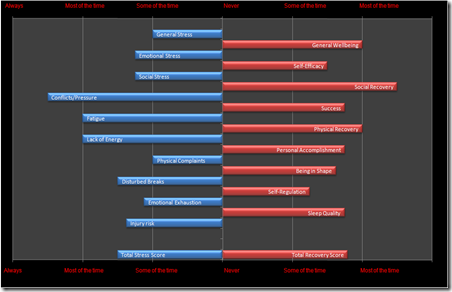
The graph normally looks like this one presented by James Marshall in his blog:

Figure 1

However, you can develop your own spreadsheet to score it and graph it as I did.
image

Many studies have shown how valid and reliable this test is. However one of the most interesting ones was published by Jurimae et al. (2004). They studied the effects of increasing training loads in competitive rowers and found significant relationships between training volume and Fatigue scores (r=0.49), Somatic Complaints (r=0.50} and Sleep Quality (r=-0.58) at the end of heavy training. In addition, significant relationships were also observed between cortisol and Fatigue scores (r=0.48) at the end of heavy training as well as between changes in cortisol and changes in Fatigue (r=0.57) and Social Stress (r=0.51).

It should be pointed out that this test cannot be performed every day as it asks the athlete about how often the respondent participated in various activities during the preceding three days/nights. A Likert-type scale is used with values ranging from 0 (never) to 6 (always) to rank the frequency of activities/experiences of the preceding 3 days/nights.

BORG scale and perception of effort

The concept of perceived exertion was introduced half a century ago and an operational definition presented with methods to measure different aspects of perceived effort, strain and fatigue. One very common method is the RPE-Scale for "Ratings of Perceived Exertion" ("the Borg Scale") officially known now as the "Borg RPE Scale®".

As Professor Borg explains: “Stevens' "Ratio (R) scaling methods for determinations of S-R-functions have been improved in order not only to obtain relative functions but also direct ("absolute") levels of intensity. This was done by placing verbal anchors, from simple category (C) scales (rank order scales) such as "very weak", "moderate", "strong" etc at the best possible position on a ratio scale, a "CR-scale", covering the total subjective dynamic range, so that a congruence in meaning was obtained between the numbers and the anchors”.

If you are really interested in this you should read Dr. Elisabet Borg’s thesis here where she presents the innovative approach to develop the "Borg CR100 Scale®" (also called the "centiMax Scale"). I had the pleasure to listen to her lecture last year in Italy and I was impressed by the quality of work she has done to follow up her father’s intuitions on the original rate of perceived exertion.

You can read more about Dr. Elisabet Borg here and about Professor Gunnar Borg here.

Recommendations to use a "Borg Scale" is given by many professional societies, e.g. American Heart Association www.americanheart.org, American Thoracic Society www.thoracic.org, American College of Sports Medicine www.acsm.org, British Association for Cardiac Rehabilitation www.bacrphaseiv.co.uk.

These scales can be obtained from the firm: "Borg Perception", Gunnar Borg, Rädisvägen 124, 165 73 Hässelby, Sweden. Phone 46-8-271426. E-mail:borgperception@telia.com.

Other alternatives

There are various tools out there these days such as the following ones:

  • Life Stress (LESCA)
  • State trait anxiety inventory (STAI)
  • Athletic coping skills inventory (ACSI)

however I have no experience in using them…maybe some of you readers know more and what to write comments about any of them?

Enough info now for psychometric tools…next post will cover aspects connected to strength, power and speed.

Saturday, 1 May 2010

Talent…or repetitions?

I have been having few debates with colleagues on the topic of Talent and talent ID programmes. Due to the success of some talent transfers in some physical sports, there seems to be a large number of people convinced that such approach can also be successful in team sports. Needless to say I totally disagree with that. Having worked as a coach developing young athletes and as a coach of senior athletes in a team sport I can definitively say that in order to produce a World Class team you need to have the talent in the team as well as people who have done thousands of hours perfecting their skills. You just cannot change an average Basketball player in his/her 20s in a World class handball player and vice versa, you cannot identify a tall guy/girl and within 4 years turn him/her into a World class volleyball player. Why not? Simple: because no matter how physically talented they are, it is unlikely they can make up in few years for the lost time of practice as compared to people who started their sport when they were children. If you believe that nobody in 4-5 years can become as good as Lionel Messi having never played football, then you are part of my club.

I am not going to write about this issue in this post, but I promise will write more as talent id-ing is really an interesting field, and I am passionate about its proper applications at the right age group and understanding also the limitations in the possibilities of talent transfer in particular in some sports.

I have recently come across Daniel Coyle’s blog, and it is a refreshing read proving that talent alone is not enough and in many fields it is possible to reach success using a variety of training coaching methods, motivation and coaching. Most of all he talks about the importance of deliberate practice when an incredible number of repetitions are performed which allow someone to become a master in a specific field.

image

I have ordered the book and I am looking forward to read it, in the meantime, I am enjoying the blog which is plenty of useful examples in sports.

Technorati Tags: ,,

Thursday, 31 December 2009

Handball and sports science….why so behind?

Handball (also known as team handball, Olympic handball or European handball) is a team sport in which two teams of seven players each (six outfield players and a goalkeeper) pass and bounce a ball to throw it into the goal of the opposing team. The team with the most goals after two periods of 30 minutes wins. Handball is by far my favourite sport. I played handball for many years in Italy (a bit more seriously) and for a couple of years in Scotland (for fun) and was a coach for few years and despite the fact I am not coaching handball anymore, I still cannot believe how old fashioned handball training is.

Handball is a professional sport in many countries. In Germany, Spain, Denmark and Norway and many other European countries (mainly in Eastern Europe) there are full time coaches, players and support staff. The European Champion’s League is televised on Eurosport and in some games you can see more than 15000 supporters watching the game! In few words…it is a serious business!

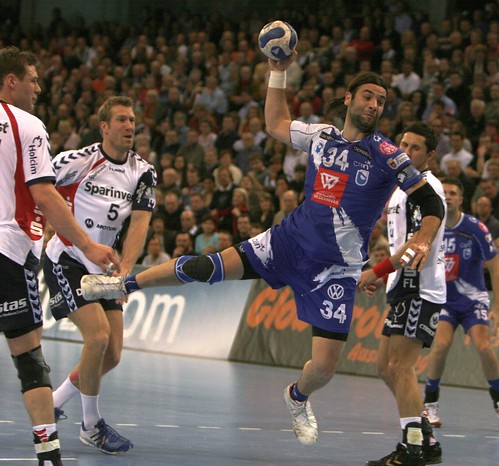
(The Croatian Ivano Balic….possibly the best player in the World for Men’s Handball)

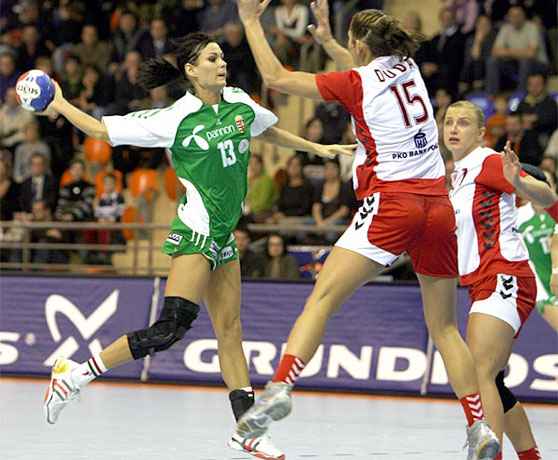
(The Hungarian Anita Görbicz….possibly the best player in the World for Women’s Handball)

If you have never seen a game of handball….you can get some ideas of how it is played on YOUTUBE.

Handball is a sport which is growing very fast in terms of spectators and media coverage, and is one of the top sports in Europe in terms of employment opportunities for coaches and sports scientists. Handball is an Olympic sport since 1972 in its indoor version. However, despite all the media interest, the sponsorships and the fact that Olympic medals are at stake, very little is available in terms of sports science. Very few research activities have been conducted and there is a paucity of published literature. A simple analysis on pubmed using the keyword “Handball” provides 343 entries (with many papers on injury rates and/or on a different sport also called Handball and played mostly in the USA and Canada). A keyword search for Basketball presents 1734 papers, and volleyball presents 693. In simple terms, there is clearly a paucity of information on Handball.

When we then analyse the scientific literature available, we then realise how little has been published on training and performance aspects as most of the literature refers to injuries in Handball.

A very recent review from Ziv and Lidor (Ziv, Gal and Lidor, Ronnie(2009) 'Physical characteristics, physiological attributes, and on-court performances of handball players: A review', European Journal of Sport Science, 9: 6, 375 — 386) has summarised all the available literature on handball and highlighted how little is known about this wonderful sport.

I have previously discussed on this blog specific aspects of physical preparation of handball players. However I would like to point out again that little is known about physiological demands and most of all about physiological characteristics of elite handball players. Ziv and Lidor summarised in Table 1 of their paper what has been so far published:

image

From the paucity of data on elite performers, you can clearly see that elite handball players are bigger and have more muscle mass than non elite. When I worked in Italy we used to benchmark our youth national teams and seniors with the World elite and it was always clear that in order to be World leading in this sport you needed height and fat free mass in particular in some playing positions.

Endurance capacity has always been a matter of discussion in the Handball coaching community. Despite the fact that Handball is clearly an intermittent sport (played on a 40m court!), a lot of attention was always devoted to endurance capacity. However data clearly show that handball players have a VO2max of 50-60 ml.kg.min-1, indicating that probably endurance capacity per se is not the most important performance-limiting factor. This has been supported by one scientific paper published by Gorostiaga et al. In fact, they conducted a study that examined endurance capacity in elite and amateur handball players while running at 10, 12, 14, and 16 km/h found no differences in mean blood lactate concentration or in mean heart rate (Gorostiaga et al., 2005). The mean running velocity and heart rate that elicited a blood lactate concentration of 3.0 mmol. l-1 were similar in both elite and amateur players, suggesting that endurance capacity per se does not differentiate elite from amateur handball players. In addition, no significant differences in endurance running at 10, 12, 14, and 16 km/h were observed in elite players over the course of a season (Gorostiaga et al., 2006). Despite this, a lot of handball coaches still put emphasis on training endurance capacity mostly in the form of long steady state running. However, it is important to state that we don’t have data on the top 5 national teams in the World and we have no idea if they are really different from the rest. Also, considering how fast the game is now played, we should clearly reconsider how to train handball players as I suspect metabolic demands are a lot higher than the ones recorder in the early 80s.

The most recent work on motion analysis characteristics is the one published by Luig et al. (2008) which conducted time-motion analyses during nine games of the 2007 men’s World Cup. The analyses were conducted using a computerized match analysis system. Four movement categories were defined in this study: walking, slow running, fast running, and sprinting. Playing time was significantly higher in wings (37.37 +/- 2.37 min) and goalkeepers (37.11 +/- 3.28 min) than backcourt players (29.16 +/- 1.70 min) and pivots (29.3 +/- 2.70 min). Total distance covered was higher in wings (3710.6 +/- 210.2 m) than in backcourt players (2839.9 +/- 150.6 m) and pivots (2786.9 +/-238.8 m). As anticipated, goalkeepers covered the shortest total distance (2058.1 +/-90.2 m). The total distance covered by field players consisted of 34.3 +/- 4.9% walking, 44.7 +/-5.1% slow running, 17.9 +/- 3.5% fast running, and 3.0 +/- 2.2% sprinting. Compared with other players, wings covered significantly shorter distances while slow running but significantly longer distances while fast running and sprinting. The distances covered are a lot less of what was reported in the 80s and is possibly due to how the game has changed with a better use of substitutions during the game to make sure players can perform fast movements for almost 21% of the total distance covered. To date, no study has been performed on oxygen consumption during handball games, but it is quite easy to predict what to expect considering the fast pace of handball playing. Quite simply, there is no information on handball performance which can help coaches identifying what the real demands are in particular at the very elite end of performance. I am sure data exist possibly in languages I cannot read and understand, I would be in fact very surprised if the elite handball nations don’t have such data to identify what they need in order to win an Olympic medal.

More data exist on strength and power capabilities and how training can influence throwing speed:

image

image

Again, few data here, but it seems feasible to suggest that strength training can improve throwing speed at least in non-elite players. The effectiveness of strength training on improving throwing speed in World class players is debatable mainly because there are no data to support or disprove this possibility. However, considering that Gorostiaga et al found a significant correlation between total strength training time and standing throwing velocities (r=0.58), and with my group we always improved throwing speed in national team players following a strength training programme, it seems feasible to suggest that strength training can improve throwing speed even in elite players. Throwing speed is of course only one part of the story, as accuracy is needed in order to score a goal as well as the ability to “beat” the goalkeeper. Incredibly there is virtually no information on interventions able to improve accuracy in handball players….

Handball is quite a demanding sport and being a “contact” sport eposes the players to a relatively high risk of injuries. Data from Beijing Olympics (Junge et al. 2009) clearly shows the high injury rates observed in Handball. 92% of the injuries occurred in competition. Of course during the Olympics teams tend to lower the intensity of training sessions and minimise physical contact in order to avoid injuries. However, it would be interesting to investigate injury rates in training and competition to find out if training sessions are too far from the competition demands as I suspect this is the case in many countries.

image

Who is going to invest in research activities on handball performance? Which country will be able to identify marginal gains to produce better players? Which country will be able to identify nutritional strategies to maximise performance in handball?

Maybe in few years we will have an answer, in the meantime, we can enjoy the competitions and hope that more research activities will be published on peer reviewed journals and websites for the good of coaches and players.

Wednesday, 23 December 2009

Playing videogames and social networking….good news or bad news for sports people?

It has become a matter of discussion in recent years and most of all a matter of concern for most of us working in sport: video games. Athletes nowadays travel with their playing consoles around the World, spend a lot of time updating their social network sites and personal websites, watch DVD and do all sorts of things in their “downtime” which are totally different from the old times when they used to go out for a walk, play cards and/or read.

Times change, habits and behaviours change and we are all totally taken by the fast advancements in technology which nowadays provides us also with entertainment tools so small that they are able to travel with us.

Image copyright (http://sarah-land.ning.com/)

While the use of such tools can be seen as a useful way to keep the athletes “indoor” and avoid the dangerous temptations of wondering outside the hotels and training camps facilities, we should have a more critical approach to the problem and try to understand how we can control the use of technology to make sure that it does not become “abuse” and it starts to impair performance.

I would like to discuss few examples and provide the rationale for my thinking. Ideally I would like to stimulate some discussion and possibly stimulate some research activities in this area, as I strongly believe it needs investigation as I have seen some quite spectacular effects of athletes playing all night with videogames and messing up their training and/or their competitions!

First of all then, let’s discuss video games.

My suggestion to all athletes travelling to Beijing last summer and to all athletes travelling to Vancouver this winter is to avoid at all costs playing video games, watching DVDs, using computers at night if they wake up because of Jet Lag. My rationale is pretty simple. In order to quickly recover from Jet Lag we need to make sure that sleep occurs at the right time of the day-night cycle. Most of the times, some athletes don’t consider getting help from sleeping tablets and tend to tackle the issue with bed routines. However, when they wake up at 3 am with their body thinking it is time for lunch or dinner, they should make every possible effort to avoid being exposed to light and should make every effort to get back to sleep. Why that? Playing a video game on a computer or game console, using a laptop for social networking and watching a DVD can expose you to up to 300 nits (unit of measure of luminance) of light. The pattern of light is also strong and intermittent.

Light exposure through the visual field has been shown in various studies to stimulate brain areas leading with circadian control and the pineal gland dealing with hormonal pulsatility. Circadian rhythms in physiological, endocrine and metabolic functioning are in fact controlled by a neural clock located in the suprachiasmatic nucleus (SCN).

(Image from “The New Genetics”, US Department of Health: http://publications.nigms.nih.gov/thenewgenetics/thenewgenetics.pdf)

This structure is endogenously rhythmic and the phase of this rhythm can be reset by light information from the eye. It is therefore possible that if somebody is exposed to light of the intensity produced by laptops and similar tools coupled with physiological and psychological arousal generated by the interactive nature of the tools (e.g. video games and social networking chats) might delay adaptation to the new time zone. In simple terms, this is pretty much because light exposure is telling your brain it is time to wake up! In humans, bright light exposure early in the biological night delays circadian timing, while bright light exposure late in the biological night advances circadian timing (Khalsa et al., 2003). However, the levels of light exposure employed to shift the circadian clock have typically been fairly high, ranging from 2,500 – 10,000 lux (Crowley et al., 2003; Czeisler et al., 1990; Horowitz et al., 2001), far above the lighting received by a Laptop screen. However usually laptops and video games use is associated with physiological and psychological stress which could contribute to altered sleep patterns not only in jet-lagged subjects but also in athletes in a training camp that have not crossed any time zone.

The effects of light are not the only concern. Playing certain video games has been shown to have some interesting physiological effects. Children playing Tekken 3 (Namco Hometek Inc) where shown to have Significant increases from baseline for heart rate (18.8%; P<.001), systolic (22.3%; P<.001) and diastolic (5.8%; P=.006) blood pressure, ventilation (51.9%; P<.001), respiratory rate (54.8%; P.001), oxygen consumption (49.0%; P<.001), and energy expenditure (52.9%; P<.001). Effect sizes for these comparisons were medium or large. No significant changes were found from baseline to after video game play for lactate (18.2% increase; P=.07) and glucose (0.9% decrease;P=.59) levels (Wang & Perry 2003).

image

Children playing for 60 minutes Need for Speed—Most Wanted (Electronic Arts, Redwood City, CA presented impaired sleep patterns and a reduction in verbal cognitive performance (Dworak et al. 2007).

Despite the fact that a violent video game (Over 85% of games contain some violence, and approximately half of video games include serious violent actions [e.g., Children Now, 2001]) does not seem to determine an increase in cortisol levels (Ivarsson et al., 2009) it is clear that it is capable to provide enough physiological and psychological disruption to a normal sleeping pattern. The disruption of normal sleeping patterns can be deleterious in an athelte trying to get into a normal sleep routine after having crossed few time zones.

The smaller video game literature has found that playing violent video games causes increases in aggressive behaviour, aggressive cognitions, physiological arousal, and decreases in prosocial behaviour (Anderson et al., 2004).

Ivarsson et al (2009) showed a strong influence of violent video gaming on heart rate variability indices. In particular total power and very low frequency of the r-r intervals was shown to be higher while playing a violent video game as compared to a non-violent one.

At the moment there is no study which has been looking at the effects of playing computer games at night on performance. However all the information I cited before seems to suggest some marked negative influences in particular if the athlete is travelling to a new time zone.

So, what is the advice then?

1) If your are travelling to a trainining and competiton venue and are crossing time zones, avoid using your laptop, DVD player, Ipod and similar tools and video games devices during the night. Get back to sleep!

2) If you are training and or competing the following day, avoid all of the above the night before such activities (training and competing) take place

3) Recovery time is meant to be for rest and piece. You don’t want to play street fighter with your best mate and have your blood pressure, heart rate and cortisol levels go sky high because you lose!

4) There is a time and place and most of all a duration for your gaming and computing activities, make sure you don’t negatively affect your performance because of that!

Popular Posts


Followers