Thursday, 30 April 2015
Functional nonsense. The new "F" word.
Friday, 27 February 2015
New article published on strength training for the elderly
In 2013 I was kindly invited by my colleague Dr. Urs Granacher in Potsdam to give a talk to his institution about science in sport. During my stay we discussed about many aspects of sports science and spent a lot of time talking about bilateral deficit and the fact that there was not much research on assessing it in various populations and also on the effectiveness of various training interventions on this interesting neuromuscular phenomenon. In particular, I was concerned with the amount of training prescriptions characterised by exercises involving two limbs, while most movements are performed with one limb. Also, we discussed how this was relevant for the elderly, as the risk of falls is large for older people and falls occur normally when most of the weight is supported by one leg.
Discussions moved to actions, and the project has been now published on Plos One. The abstract is below and if you want to read the article you can click on the image.
Abstract
Sunday, 5 December 2010
Strength and Conditioning Book
It all started with a chat at a conference few years ago with my colleagues and friends Rob Newton and Ken Nosaka discussing the need of a comprehensive textbook on strength and conditioning providing information on the biological bases as well as practical applications.
This book is finally a reality thanks to the help and support of many colleagues who agreed to contribute to this project providing excellent chapters and creating a unique resource which we hope will be well received by anyone interested in Strength and Conditioning.

This book provides the latest scientific and practical information in the field of strength and conditioning. The text is presented in four sections, the first of which covers the biological aspects of the subject, laying the foundation for a better understanding of the second on the biological responses to strength and conditioning programs. Section three deals with the most effective monitoring strategies for evaluating a training program and establishing guidelines for writing a successful strength and conditioning program. The final section examines the role of strength and conditioning as a rehabilitation tool and as applied to those with disabilities.
The book is already available on Amazon and other online booksellers in hardcover and paperback editions.
A big thanks to our production team at Wiley-Blackwell and all the colleagues contributing to the chapters.
Details of the chapters are available here:
Foreword (Sir Clive Woodward).
Preface.
1.1 Skeletal Muscle Physiology (Valmor Tricoli).
1.2 Neuromuscular Physiology (Alberto Rainoldi and Marco Gazzoni).
1.3 Bone Physiology (Jörn Rittweger).
1.4 Tendon Physiology (Nicola Maffulli, Umile Giuseppe Longo, Filippo Spiezia and Vincenzo Denaro).
1.5 Bioenergetics of Exercise (R.J. Maughan).
1.6 Respiratory and Cardiovascular Physiology (Jeremiah J. Peiffer and Chris R. Abbiss).
1.7 Genetic and Signal Transduction Aspects of Strength Training (Henning Wackerhage, Arimantas Lionikas, Stuart Gray and Aivaras Ratkevicius).
1.8 Strength and Conditioning Biomechanics (Robert U. Newton).
2.1 Neural Adaptations to Resistance Exercise (Per Aagaard).
2.2 Structural and Molecular Adaptations to Training (Jesper L. Andersen).
2.3 Adaptive Processes in Human Bone and Tendon (Constantinos N. Maganaris, Jörn Rittweger and Marco V. Narici).
2.4 Biomechanical Markers and Resistance Training (Christian Cook and Blair Crewther).
2.5 Cardiovascular Adaptations to Strength and Conditioning (Andy Jones and Fred DiMenna).
2.6 Exercise-induced Muscle Damage and Delayed-onset Muscle Soreness (DOMS) (Kazunori Nosaka).
2.7 Alternative Modalities of Strength and Conditioning: Electrical Stimulation and Vibration (Nicola A. Maffiuletti and Marco Cardinale).
2.8 The Stretch–Shortening Cycle (SSC) (Anthony Blazevich).
2.9 Repeated-sprint Ability (RSA) (David Bishop and Olivier Girard).
2.10 The Overtraining Syndrome (OTS) (Romain Meeusen and Kevin De Pauw).
3.1 Principles of Athlete Testing (Robert U. Newton and Marco Cardinale).
3.2 Speed and Agility Assessment (Warren Young and Jeremy Sheppard).
3.3 Testing Anaerobic Capacity and Repeated-sprint Ability (David Bishop and Matt Spencer).
3.4 Cardiovascular Assessment and Aerobic Training Prescription (Andy Jones and Fred DiMenna).
3.5 Biochemical Monitoring in Strength and Conditioning (Michael R. McGuigan and Stuart J. Cormack).
3.6 Body Composition: Laboratory and Field Methods of Assessment (Arthur Stewart and Tim Ackland).
3.7 Total Athlete Management (TAM) and Performance Diagnosis (Robert U. Newton and Marco Cardinale).
4.1 Resistance Training Modes: A Practical Perspective (Michael H. Stone and Margaret E. Stone).
4.2 Training Agility and Change-of-direction Speed (CODS) (Jeremy Sheppard and Warren Young).
4.3 Nutrition for Strength Training (Christopher S. Shaw and Kevin D. Tipton).
4.4 Flexibility (William A. Sands).
4.5 Sensorimotor Training (Urs Granacher, Thomas Muehlbauer, Wolfgang Taube, Albert Gollhofer and Markus Gruber).
5.1 Strength and Conditioning as a Rehabilitation Tool (Andreas Schlumberger).
5.2 Strength Training for Children and Adolescents (Avery D. Faigenbaum).
5.3 Strength and Conditioning Considerations for the Paralympic Athlete (Mark Jarvis, Matthew Cook and Paul Davies).
Monday, 21 June 2010
iPhone application for strength testing and training
I have just received a link to a new promising application developed for iPhone/iPod touch capable of using the accelerometer housed in the smartphone to be able applied to barbells for strength testing and for monitoring strength training.
The application is called LIZA and is available here.
It seems clear from the screenshots that it is possible to record the power/load relationship and calculate also velocity of the barbell:
And it seems to also offer the ability to compare tests performed at different times:
After testing is also capable of identifying maximum power and the load corresponding to maximum power output:
A lot more info are also available in real time and as summary feedback to be stored and to be sent via email.
A video of how it works is available here.
It seems a very promising tool for personal trainers as well as for Strength and Conditioning coaches. At the moment there is no information available on the validity and reliability of the power calculations and on the accuracy of the using the accelerometer housed in the iPhone/iTouch. I am sure soon we will see some validation papers on this tool considering the fact that the University of Udine is involved in its development. Also, 1RM is estimated from the load/velocity relationship.
Liza offers also a lite version. According to the website, the lite version allows to perform the half squat test, to view the resulting data and send them via email or twitter just like the standard version; it is not possible to get any graphic representation nor save any data. The lite version displays some advertising banners.
I don’t use iPhone/iTouch, so I suggest the readers to download this application and decide for themselves if it is something worth having. Considering the cost and the fact that you don’t need any extra device, I suggest this is something worthwhile trying for any professional interested in measuring the outcome of strength training programmes.
Sunday, 21 June 2009
Training team sports athletes: Periodization and planning strategies. Part 2
Time goes fast and I just realised how long ago I wrote the first part of this article. So, let’s try to start from where I left.
Monitoring training and avoiding mistakes was the topic I left the readers with. Generally speaking, technology in this field is moving very fast and in the very near future I envisage the ability to be able to monitor physiological and behavioural responses to training in team sport in real time, with the ability to make some sensible decisions to optimise training gains in team players.
Heart rate monitoring for example has become nowadays accepted standard practice in the team sports World and also in the Football/Soccer environment nowadays many training sessions are monitored to quantify the effort of the players and the characteristics of the drills employed by the coaches.
In order to quantify training intensity, due to the intermittent nature of team sports, time spent in various intensity zones is quantified. A simple classification is presented and it is based on defining zones with heart rate presented as a % of Heart Rate Max or Heart Rate Reserve.
Of course, in order to have a precise determination of such training zones it is important to measure Heart Rate Max rather then using the 220-age estimation.
Because of the linear relationship between the intensity of exercise and the perception of effort, a simple scale is proposed here:
Heart Rate measurements can be used to define not only the overall intensity of the training session, but also the intensity and demands of individual sessions. This approach allows the coach/S&C coach to develop a database of drills which can impose on the players similar demands in order to be able to change sessions and reduce the boredom factor.
By using Heart Rate based measures in combination with blood lactate it is in fact possible to compare game-specific drills with more generic drills such as intermittent sprinting and/or repeated sprints and verify the demands on the same player of such activities.
In the following example we can see how intermittent sprint drills (10s activity-20s rest) provided a similar physiological response to 3 vs.3 in Handball players.
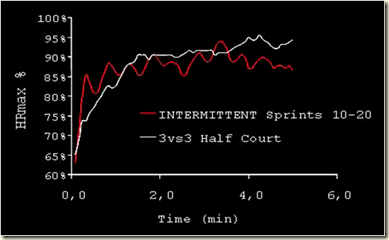
This suggests that when training time is limited, the use of well planned technical and tactical drills can represent a significant training stimulus. Of course, what is important to remember is the fact that game-like drills can be effective only if we know how demanding they are. The physiological responses to such drills depend in fact on the rules used in the drills, the space, the number of players and the quality of the players involved. Generalising data findings from other sources is not the way to plan training. In order to successfully implement game-like activities in your training programme requires accurate measurement of the physiological demands in your particular group of players.
In elite team sports athletes it is also effective to plan specific sessions in which game-like drills are combined with more generic repeated sprint drills. A practical example could be to alternate 10 minutes of a game-like drill with repeated sprint drills (such as shuttle runs etc.).
This approach can be very effective and can lead to improvements in aerobic capacity without the need to dedicate too much time to training activities which not involve technical and tactical elements. The following data are the yo-yo test distance scores of an elite handball team performing for one month training sessions characterised by game-like activities mixed with intermittent work.
This is of course only part of the picture. In team sports we want athletes to be able to perform high-intensity movements for the duration of the game, but we also want them to be fast, strong and powerful. Strength training and monitoring activities aimed at maximising gains in this area of the players’ fitness are very important and will be now discussed.
Strength and speed
First of all, we have to take into account what kind of variables we are interested in. Acute variable can help us in understanding how a session is going and how it is affecting the player.
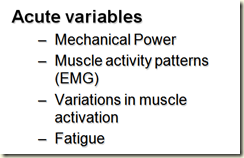
Chronic variables can give us more information on how effective a period of training has been and where is our training programme leading to.
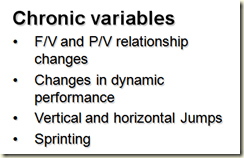
The use of measurement tools to analyse single sessions can be a very useful way to understand how the athlete is coping with the load we have imposed on him/her and also to understand how fatiguing is the session. If heart rate monitoring is important to understand the physiological demands of game-like drills, we need to use some form of monitoring to understand the responses to strength training sessions. Iso-inertial dynamometers are becoming more and more affordable and can provide a good solution. Monitoring strength training sessions offers the following benefits:
However the last point is the most important one: if your monitoring activity does not provide data which are useful to improve your training prescription you are just collecting data which will not impact on the quality of training!
The following is a typical example of monitoring a training session using a linear encoder during a Bench Press exercise. Two athletes are lifting the same weight, they both have similar 1RMs, however by measuring their power output during the set we can see how different fatigue patterns occur:
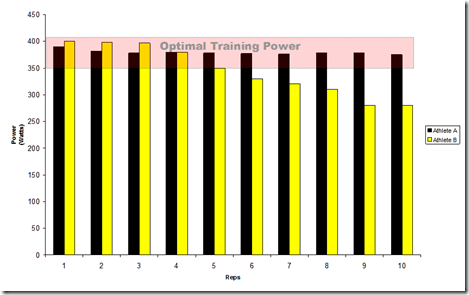
If the aim of the session/programme is to maximise power output, we need the athletes to be able to produce power within 90-100% of their maximum power for the given load. By monitoring how they respond (provided that they are encouraged to perform the concentric phase of the lift as fast as possible), we can improve our training prescription by dividing sets and reps to make sure the target power output is attained for the total volume of reps we want the athlete to perform in our programme.
Why such focus on power and speed of movement? Simple, it seems that during rapid movements an increased activation of fast motor units or decreased activation of the slow ones may occur. So, if we aim to improve power and speed in our athlete we should always ask them to perform the concentric phase as fast as possible. The work of Linnamo et al. (2002) can explain in justifying such approach. In their study, Linnamo and coworkers had 6 subjects with different fiber type composition characteristics:
This is what you would typically encounter in a team sports scenario. They asked the subjects to perform two types of sessions (explosive and heavy resistance):
[EE] 5 x 10 reps @40+ 6% of MVC
[HE] 5 x 10 reps @67 + 7% of MVC
MVC is the maximal voluntary contraction (measured isometrically).
The difference in the median frequency of the surface EMG (after rectification and fast fourier transformation of the EMG raw signal) between the two modalities of exercise clearly suggest a difference in motor unit recruitment patterns when performing the two types of loading. Note that the sets and reps where the same, with a difference in external load and velocity of movement.
By measuring in real time such parameters it is possible to change the session while it is being performed (again, if the aim of such session is to improve power and speed). The following example from Lore Chiu and coworkers (2004) shows that if you are monitoring the speed of the barbell/weight stack and you observed a decrease in speed, of course by changing the external load you can make sure the speed of execution is increase and is matching what you planned for.
The key message here is that we should still plan sessions with sets x reps x load, but we should be able to measure the output in order to make sure the athlete is performing what we require in order to maximise the adaptations and make sure he/she is not wasting time in the gym!
Monitoring strategies to identify recovery and readiness to train
While everyone tends to accept the general adaptation syndrome paradigm, whereby a training stimulus challenges homeostasis and takes a certain amount of time to be recovered. Very few people actually measure what it means and if it is possible to track the various phases of responses to a single training session.
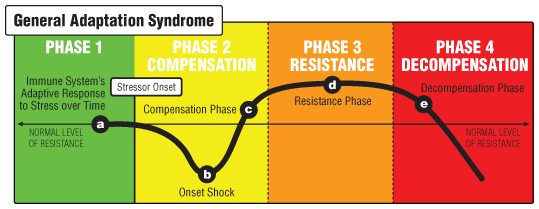
The following approach is an example conducted with an Handball team using vertical jumping tests (in this case the Counter Movement Jump [CMJ]) before, during and after a session of plyometrics (approximately 200 jumps in total). You can see that while the team average score seems to be recovered within 24 hours of such session, some individuals have recovered (BP) and some haven’t (SO). Individualisation should be a fundamental approach to team sports! But if you don’t measure anything…how can you individualise? While everyone talks about it, I still see scarce evidence of this actually occurring, where are the data?
Biochemical monitoring of training, long term monitoring of adaptations
I have already presented examples of monitoring training load and adaptations in some team sports showing that different approaches of periodisation can be used depending on the level and the performance goals of the team and both approaches can produce improvements in the players when it counts (http://marcocardinale.blogspot.com/2007/12/strength-training-in-volleyball.html) if you know what you are doing.
Testing modalities and ways of tracking individual and team progress have also been discussed here before. I will spend few words with regard to hormonal monitoring which is now becoming something everyone claims to be an expert in. I recently came across a lot of manufacturers which claim can sell devices able to measure quickly (almost realtime) salivary concentration of hormones (in particular Testosterone and Cortisol) and/or measure hormones in capillary blood.
I regret to inform all readers that to my knowledge there isn’t a single device which provides good reliability and validity of the measures taken, furthermore while measuring such things can be useful, it is still an expensive exercise which requires time and most of all real expertise not only in conducting the necessary assays to measure hormone concentration but also in understanding the validity and the meaning (and most of all the limitations) of the data collected.
To real make and impact, hormonal monitoring should be performed routinely, with many data points during the day, and following strict guidelines in terms of sample collection, storage, preparation and analysis. Collecting only baseline morning fasting hormonal measures might not help in explaining the bigger picture. In the example below, Cortisol levels are presented during the course of the day showing a clear circadian pattern. The Blue line represents “normal” patterns of cortisol secretion. The red and the black line represents alterations I have observed in some athletes following specific training periods. The red and black dots represent the single point, morning fasting sample. As you can see, having only 1 data point might mislead you….as clearly while the subject represented by the black line would appear to have lower cortisol values in the baseline sample, his cortisol pattern is different from normal and his cortisol values are actually overall higher during day and night suggesting some indications of overreaching/overtraining.
There is a clear message here. Beware of the so called experts…hormonal monitoring is an interesting field, but still no conclusive evidence on how it actually work, most of all, very few people understand it but many are out there selling all sorts of services and “expertise”. The use of testosterone and cortisol as biomarkers to understand training adaptations is an interesting field but requires the appropriate knowledge of physiology, techniques and limitations in order to be used to make the “right calls” when it comes to training prescription. In the last few weeks I have been working with my colleagues Blair Crewther, Christian Cook, Robert Weatherby and Paul Lowe on an extensive literature review addressing the evidence and implications of the short term effects of testosterone and cortisol on training adaptations and performance. I will keep the readers up to date when such paper is published (hopefully soon).
Conclusions
Writing training programmes is a mix of art and science. The scientific model should drive any inquisitive strength and conditioning coach in designing appropriate and effective programmes. Team sports are challenging in terms of trying to maximise performance with strength and conditioning programmes. They are challenging because of the different types of athletes involved in them, the complexity of the performance requirements and the difficulties of seasons with cups, playoffs etc. The only way to succeed is to approach training with an “evidence-based” attitude. Trying to put in place measurements and monitoring tools able to inform and guide the training process. The devil is always in the details. Group analysis should be followed by individual analysis in order to develop individualised programmes aimed at maximising performance in each single athlete of your team. Statistical procedures should be used to understand and treat the data better, but the attitude towards such approach should be to gain a better understanding of training adaptations rather then trying to find what is significant at P<0.05. As my friend Will Hopkins wrote some time ago:
If a treatment shows an improvement with P<.01 it means that there is a probability of 99% of the treatment being effective.
HOWEVER
If you are terminally ill, would you take a pill that gives you 80% chances of surviving (P<.20)?
In athletics terms…if a training programme can give you 80% chances of a 2% improvement which could win you a gold medal…would you use it…or would you wait for P<0.05?
Wednesday, 7 January 2009
Training team sports athletes: Periodization and planning strategies. Part 1
I decided to write this article after reviewing an old set of slides of a presentation I gave to the English FA few years ago entitled: “Preparing for performance: League vs. tournament”. I have been reading/listening to few individuals talking and writing books about training in team sports and I would like to add my views on this issue. There are many strength and conditioning coaches and/or fitness specialists working with team sports in Europe (in particular Football [or soccer as our American colleagues like to define this sport]) who claim some miraculous training paradigms and/or describe amazing effects of their training regimes. It is absolutely a great sales pitch, however the reality most of the times is not as depicted. Just looking very simply at the competition schedule of an elite European Football Club we can understand that these athletes have very little time to train, hence, very little possibilities to get faster and stronger.
So, what I will write about in this brief article is:
•Planning issues
•How to establish realistic goals
•Establish Training Priorities
•Individualise training
•Acute vs. Chronic effects of Strength & Conditioning sessions
•Monitoring training effects is the only way to reduce mistakes
Let’s address the first one: Planning training in an elite football team [playing the European season]
Many people still like to read Eastern European literature on periodization and/or American books on this topic. All of the above publications describe a pedagogical process build on observations conducted on athletes competing in individual sports and mostly in endurance-type of sports where understanding training loading and tapering is of absolute importance. We could argue on the scientific merit of such observations and on the fact that maybe most of the athletes under observations were using all sorts of illegal “help”, but this is not the aim of this article so, will not discuss it here.
What we can argue is that all of the above publications tend to divide the planning of training in relatively long phases (Anatomical adaptation phase [few weeks], Pre competition/hypertrophy phase [few more weeks} and the list goes on). In reality, if we look at the official schedules of elite football teams in Europe, we realise that such process cannot be really applied to footballers. Professional teams in fact tend to start training few weeks after ending the previous season, and start competing very early with limited amounts of time to actually train the players hard enough to produce meaningful adaptations. I am not saying that footballers don’t work hard and/or don’t improve. What I am trying to say is that the workload is not big enough to produce massive changes in performance be it endurance capacity and/or strength and power abilities.
But, let’s look at some real information and add some material for discussion.
Here is the training and activities schedule of FC Barcelona as reported by their website in 2006:
1st Training session: 17th of July
July 2006
Denmark –> 28 Jul Pre-season friendly AGF – FC Barcelona (11 days after 1st training session-)
August 2006
Mexico 04 Aug Pre-season friendly Tigres – FC Barcelona
Mexico 07 Aug Pre-season friendly Chivas-FC Barcelona
USA 10 Aug Pre-season friendly Club America – FC Barcelona
USA 13 Aug Pre-season friendly New York Red Bulls – FC Barcelona
Spain 17 Aug Spanish Supercup Espanol – FC Barcelona
Spain 21 Aug Spanish Supercup FC Barcelona- Espanol
Spain 23 Aug Gamper Tropy FC Barcelona- Bayern Munich
Spain 25 Aug European Supercup FC Barcelona - Seville
So, if we look at this schedule, take into consideration travelling times and recover from travel and competitions, from the 17th of July to the 25th of August 2006, possibly the footballers of FC Barcelona performed approximately 20 training sessions.
If they were to lift weights to get stronger/more powerful/faster, and had a frequency of 3 sessions per week with some recovery in between (at least 1 day) as it normally occurs, they would have performed somewhere around 6 strength training sessions. Now, if the first session is used for testing and establishing 1RM and some progression of load occurs, probably…they are lucky if they could perform 4 serious strength sessions. So, where does periodization fits here?
There is no time for Anatomical Adaptations (as defined by some periodization gurus) and no time for hypertrophy…How much can athletes gain from such an hectic schedule of training, competing and travelling before the season actually start? (even if arguably Spanish Supercup is the first trophy to win).
This is not an isolated example, the readers just need to browse websites of big clubs to see their schedule and do the math. Let’s look at national teams now…again from the website (official information).
Italy won the World Cup with the following preparation schedule:
22 May 1st Training session (players are just at the end of a long season)
31st May Switzerland vs Italy (friendly in Switzerland)
2nd June Italy vs Ukraine (friendly game in Italy)
12th June Italy Vs Ghana (1st game of World CUP)
Assuming they trained twice a day each day:
20 days: ~38 sessions: 9 strength sessions?
Preparing the World Cup with players coming from a long season in 20 days…how much training can you actually do and how much improvements can you see? Should the focus be on maintaining performance and be able to repeat it over the competition (World Cup in this case)?
What I am trying to demonstrate here is that there are far too many individuals lecturing around the World and working with football teams that talk a lot about periodization, but actually they have no data and/or meaningful information to share to support what they are saying. Most of all, due to the duration of the preparation phase and the intensity and characteristics of training regimes they impose, it is virtually impossible (in my view) for them to make massive improvements in any area of performance. Unless of course footballers are so de-conditioned that they can improve easily (which is also something I am lead to believe sometimes). I would also like to point out that I am generalising here, of course there are some great sports scientists out there working with professional teams that do a great job, but there are far too many selling hot air.
Training planning is about establishing realistic goals
Before starting planning a training programme for team sports it is important to answer the following questions:
- How much time do I have?
- How many training sessions can I perform with the players?
- What should be the focus?
•Improve aerobic capacity?
•Improve strength?
•Improve speed/acceleration?
•Improve flexibility?
•Prevent Injuries?
In few words, what can I achieve with the amount of time and sessions I have available?
Here are two typical examples from a club and a national team:
Let’s look at the typical weekly distribution of workloads of two professional team sport teams I worked with in the past. I indicate as S&C sessions only sessions in which the workload is purely aimed at improving performance capacity with limited technical and tactical aspects. Everything indicated with “practice” has a strong technical and tactical requirement. Each training session lasted 2hours.
The above example is typical of weeks in the competitive season. As you can see, 16% and 22% of total training time was devoted to improving physiological aspects of performance, with most of the time spent performing technical and tactical drills. What does this mean?
If a team looks “not in shape”,as some journalists like to point out sometimes, it is either because they are tired (density of competitions and travels) or because the intensity of the technical and tactical practice is not high enough to represent a training stimulus. So, while most of the time the Strength and Conditioning Coach is seen as the culprit, the coaching staff is most probably to blame as they handle and plan more than 80% of the training process. So, the role of a sport scientist working with such teams should be to guide and advice the coaching staff on how to make sure the training load is always appropriate in each technical and tactical session.
What can we conclude by looking at typical weekly practices and plans of elite football teams?
- Let’s not kid ourselves…it is impossible to improve aerobic capacity with 1h of “fitness specific” training per week!
- The QUALITY of football specific practice needs to be improved in order to improve players’ fitness
- Most of the S&C time needs to be dedicated to improve strength/speed/acceleration
- Extra “training” time needs to be directed to injury prevention activities (pre-hab, proprioception, recovery activities etc.)
- Individualised training programmes are necessary
- Monitor training sessions is very important
- Monitor how individuals adapt is crucial
Monitoring training and avoiding mistakes
It is at this point clear that monitoring training sessions is a necessary step to understand how effective the training process is and how the players are adapting/responding to the various stimuli.
What do we need to look for then when we want to implement some assessment strategies ?
- - Determine the effectiveness of football specific training drills
- - Gain information to be able to individualise the training program
- - Gain information to monitor an athlete’s progress
- - Gain information in case of injuries
Why do we need to monitor training in particular?
To make sure the loading is appropriate for what we are trying to accomplish.
What sort of testing and/or markers could be of use?
Physiological and Behavioural markers
Biochemical Markers
Hormonal and Immunological markers
What’s the cost/effectiveness?
… Part 2 coming soon…
Sunday, 20 April 2008
Ice and cold water after resistance exercise: are you sure it's a good idea?
As I mentioned in a previous post on this blog I am developing an interest in recovery strategies. I am amazed of how many tools/devices/procedures/methods are nowadays used to provide a "recovery" solution to athletes.
What I am most amazed of is the total lack of rationale behind many recovery strategies, not to mention the lack of scientific evidence for their effectiveness.
It seems to me that many strength and conditioning coaches, physiotherapists, sports scientists sometimes accept some practices without really questioning why they should be using them. Unfortunately most of the times a particular recovery strategy is used just because a winning team or athlete made extensive and public use of it.
Let's talk about Ice Baths and cold water immersion. The following picture shows what happens typically after some heavy training session these days:

| Spa-ing partners: Bulldogs players take an ice bath during a recovery session at Canterbury pool. Photo: Craig Golding:Vailable at:http://www.smh.com.au/articles/2004/09/20/1095651251602.html |
The reasons why athletes have to be exposed to this "torture" are the following as advocated by many S&C coaches and Physios:
- Helps in reducing DOMS and inflammation
- Helps in reducing swelling
- Helps in improving blood flow
- Helps in favouring recovery
In this article I will focus on the first point. There seems to be nowadays the need to make sure that Athletes have no DOMS (delayed onset of muscle soreness) after a training session and most of all there is a need to avoid inflammation.
With this approach, it seems that the focus of attention is now shifting away from what athletes normally do to improve performance: training!
What is training all about?
Athletes undergo gruelling training sessions to improve performance. They lift weights to get stronger, run/cycle/row to improve their endurance or speed. Simple!
The reason why they do it is to create an overload on their biological system to produce an adaptive response leading to a stronger muscle, a better cardio-respiratory system, stronger bones. They also do it to improve muscle biochemistry which then leads to better muscle function (i.e. buffering systems, metabolic enzymes).
In particular, when athletes lift heavy weights, they do it to determine muscle hypertrophy and to get stronger. The typical consequence of a weight lifting session is muscle damage then followed by an inflammatory phase and a regeneration phase able to determine a stronger muscle (for some interesting reading download this PDF of a review written by Prof. Priscilla Clarkson http://www.nmdinfo.net/Publications/Consensus%20Conf%202002%20Papers/Clarkson.pdf)
So, in simple terms, we want muscle damage, inflammation and swelling as their are the main signaling mechanisms triggering muscle remodelling (http://www.ncbi.nlm.nih.gov/pubmed/17887809?ordinalpos=7&itool=EntrezSystem2.PEntrez.Pubmed.Pubmed_ResultsPanel.Pubmed_RVDocSum).
Training-induced molecular and humoral adjustments, including muscle hyperthermia, are physiological, transient and essential for training effects (myofiber regeneration, muscle hypertrophy and improved blood supply). Stopping them may be not a good idea.
So, by reducing DOMS, swelling and inflammation are we stopping adaptations?
Maybe that's the case. Recent studies have shown that applying cryotherapy to muscles after training reduces the training gains. Yamane et al. (2006) exposed two groups of volunteers to the same training programme and a different recovery strategy. One group was in fact asked to rest at room temperature, the other were asked to immerse the trained limbs in cold-water post training. The results showed that the group with a normal recovery improved more and the authors concluded that cooling generally attenuates the temperature-dependent processes generated by training, in particular, hyperthermia-induced HSP formation"
Is cryotherapy actually effective in reducing DOMS?
Science says that:Cryotherapy does not reduce DOMS symptoms (Cheung et al., Sports Med, 2003)
Cold water immersion had NO effect on perception of tenderness and strength loss (Eston & Peters, JSS, 1999)
The use of cryotherapy immediately following damaging eccentric exercise may not provide the same therapeutic benefits commonly attributed to cryotherapy following traumatic muscle injury (Paddon-Jones & Quigley ,1997 IJSM)
Recovery of muscle soreness, flexibility and power at 48 hr post-game was not significantly enhanced by performing an immediate post-game recovery beyond that achieved by performing only next day recovery training (Dawson et al., J Sci Med Sport, 2005)
Sellwood et al (2007) recently concluded that "The protocol of ice-water immersion used in their study was ineffectual in minimising markers of DOMS in untrained individuals (3 x 1min immersion in ice water). This study challenges the wide use of this intervention as a recovery strategy by athletes".
There are of course many others out there...
What can we conclude?
Using cryotherapy and cold water immersion with athletes is a very bad idea if you are training them to get stronger!
If you want to reduce pain and swelling and help with recovery in athletes performing at tournaments then you are better off with other strategies. But this is something to talk about in the next article!
MC
Saturday, 22 March 2008
Using Force Platforms to characterise exercises
Strength and conditioning coaches and Physiotherapists write training and rehab programs choosing various exercises. The choice of exercises depends on many aspects:
- Goals of the programme
- Movement patterns that need to be improved
- Muscle activation patterns of the chosen exercises
- Force production during the execution of the exercises
- Characteristics of the athlete/the sport/ the rehab needs for which they are writing the programme
Pretty much we can say that everyone prescribes a series of exercises for a reason, or at least, to try to obtain a specific goal. Despite this process seems pretty straight forward, it is surprising to find out how many times rehab or training programs are not based on sound progressions. Most of the times such planning mistakes are due to the fact that Force-Time patterns and/or muscle activation patterns of the exercises are unknown. This leads many times to inappropriate choice of exercise and/or inappropriate choice of progression. This problem is particularly acute when the athlete performing the training exercises prescribed is someone trying to recover from injuries.
In this simple article I want to introduce some simple concepts and some examples of how to critically analyse some exercises analysing Force-Time characteristics and muscle activation.
I promise to present more exercises in the next articles in order to provide hopefully some useful information for strength and conditioning specialists and physiotherapists.
I am going to use a simple setup for such descriptions. A Force platform measuring vertical ground reaction force, an electrogoniometer to measure angular displacement in key joints, a surface electromyography [EMG] system to measure muscle activity in key muscles. With this setup and all sensors synchronised I can analyse various exercises and provide a quantitative analysis of the forces produced, the timing of force production, the muscle activity and angular limitations.
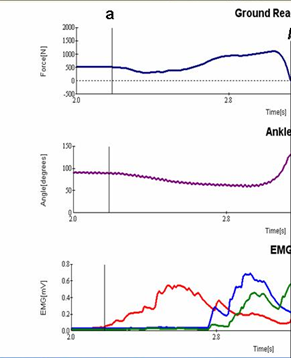
The following is an example of data that can be obtained with such setup:
We have 3 charts:
- Force-Time Curve in blue
- Ankle-Time Curve in Purple
- Surface EMGrms activity of Tibialis anterior, soleus and gastrocnemius synchronised
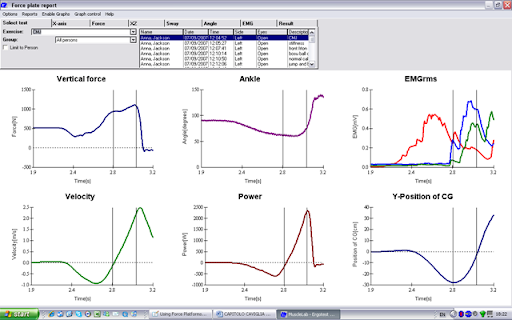
The above data represent a recording of a counter movement jump. In point a the athlete is standing still and starts moving downwards flexing the knee joint, in point b the athlete has taken off, in point c, the athlete is landing.
Now, let's look at the details:
With this simple approach we can see how the peak force reaches values that are larger than 2 times the person's body mass before take off. We can also see that the ankle contribution is limited to the last phase of take off. In terms of muscle activation patterns, tibialis anterior is very active during the downward phase of the counter movement jump, with soleus and gastrocnemius following similar patterns up until take off.
Looking at further details
Soleus and gastrocnemius EMGrms activity has a sharp rise in the moment of inversion of the movement, when the athlete starts to move upwards. Also, peak power output is reached way before full ankle plantarflexion is completed when taking off and also peak force is already reached.
The full movement lasts for 0.91s (from starting the movement downwards to take off).
Let's look at the landing phase now.
Ground reaction force (1st graph on the left) and rate of force development (RFD) are very high, actually higher than the force necessary to take off!
Muscle activation patterns are also peculiar, at landing all muscles around the ankle joint are activated in a similar pattern, with the gastrocnemius producing a larger EMGrms activity than the soleus.
So, how do we use this information in terms of exercise prescription? We know that CMJ type of jumps are requiring a force production larger than 2 times the person's body mass, they require a production of force that lasts less than 1 second (of course the above parameters depend a lot on the quality of the athlete tested) and the plantar flexors contribution is limited.
What about landings? As we have seen in this example RFD and Peak ground reaction force are actually higher in landing from a CMJ as compared from taking off. So, if we want to use similar exercises in an athlete that has some issues with the Achilles tendon and/or muscles of the lower leg, we can still do so, making sure he/she is not landing. The obvious suggestion is then to do CMJs jumping onto a box and/or providing a very soft surface to land on in order to reduce force production and RFD.
I hope this makes sense. More to come in the next articles!
Saturday, 8 December 2007
Testing team sports athletes and analysing data
Many strength and conditioning coaches and/or exercise physiologists are nowadays employed to work with team sports. Testing and monitoring training is now becoming standard practice and data analysis, data mining and the ability to produce meaningful reports is a necessary skill of the elite sports science support staff. I this short post I will not discuss the main aspects to consider when performing a test and/or the limitations of testing procedures. I will just present simple examples of reporting data using Microsoft Excel.
When dealing with large squads, single athlete's scores should be analysed and continuously monitored to make sure the athlete is progressing and improving. However, in order to profile areas of improvement it is important to compare the single athlete to the group or to a known group of elite performers.
A very simple way for doing this with excel is to collect all the data in a single sheet with the name of the athlete in the first column and all the tests scores in the following columns. Then, when the average values and the standard deviation for the team is calculated, all scores of each individual player can be transformed in Z-Scores. In Excel this is possible using the function STANDARDIZE which returns a normalised value from a distribution characterised by mean and standard deviation.
The syntax is the following:
STANDARDIZE(x,mean,standard_dev)
X is the value you want to normalize.
Mean is the arithmetic mean of the distribution.
Standard_dev is the standard deviation of the distribution.
Once each score is normalised, spider charts can be used to see how each individual player scores as compared to the team scores. Two examples are given here. Zero is the team score, every score higher than zero means that the athlete scored better than the average value, every score below zero means that the athlete scored less than the average value.
Figure 1: This is an athlete that outscores the team average values in all tests
Figure 2. This is an athlete outscored team results only in sprinting.
When we plot the results in this way we can clearly identify areas where we need to make an impact with a training programme. So, while in athlete JL we need to put a lot of emphasis on sprinting abilities, on athlete H we need to do a lot of work on strength and power. With this approach we can then track not only athlete's development in different areas but also how they evolve in comparison to his/her team scores. Individualization of training is the key aspect to take into consideration when working in team sports. Data analysis allows the coach, the physiologist and the sports scientist to profile each individual player and provide appropriate training interventions.
Popular Posts
-
How many times have your heard the following: "your gluts are not firing"? I bet many times. In the World of Strength and Conditio...
-
I decided to write this post after having seen numerous tests reports in which the results of squat jumps appear equal and sometimes higher...
-
The new buzzword in the sporting domain seems to be "Functional". Everything these days is has this F word attached to it. I ha...
orcid.org/0000-0002-2777-8707