Showing posts with label muscle physiology. Show all posts

Wednesday, 12 September 2012

New article published #3: whole body vibration effects on obese subjects

This article was published on Obesity Facts. It is the result of a collaboration i have with the Italian Auxological Institute. An organisation working every day to help obese patients and trying to develop innovative approaches to weight management. In this experiment we showed how whole body vibration with and without additional loading can induce acute increases in Growth Hormone which is very difficult to obtain with other forms of exercise in this population. In the obese, some endocrinological disturbances during acute endurance and resistance exercise have been identified inmany studies: a blunted growth hormone response, atrial natriuretic peptide and epinephrine release, and greater cortisol and insulin release. These hormonal disturbances might contribute to a suppressed lipolytic response, and/or suppressed skeletal muscle protein synthesis, as a result of acute endurance or resistance exercise, respectively. Our finding suggests that this form of exercise has the potential to be effective at least in the initial stages of an exercise programme in this population.

Obes Facts. 2012 Aug 24;5(4):567-574. [Epub ahead of print]

Growth Hormone-Releasing Effects of Whole Body Vibration Alone or Combined with Squatting plus External Load in Severely Obese Female Subjects.

Giunta M, Cardinale M, Agosti F, Patrizi A, Compri E, Rigamonti AE, Sartorio A.

Source

Istituto Auxologico Italiano, Laboratorio Sperimentale di Ricerche Auxo-endocrinologiche, IRCCS, Milan, Italy.

Abstract

Background: Whole body vibration (WBV) has been reported to exert growth hormone(GH)-releasing effects in healthy subjects. Despite the potential of WBV to positively affect body composition changes via lipolytic effects, few studies have been performed in obese subjects to date. Methods: This study evaluated the acute effects of WBV alone or in combination with squatting plus external load (WBV+S) on serum GH levels and blood lactate concentrations in 7 severely obese women (age 22 ± 5 years; BMI 39.9 ± 2.9 kg/m(2)). Results: WBV and WBV+S determined a significant GH increase (mean GH peaks 5.1 ± 1.9 ng/ml, p < 0.001 vs. basal, and 6.5 ± 3.7 ng/ml, p < 0.001 vs. basal, respectively), GH peaks occurring immediately after both exercise sessions. No significant differences were observed between GH peaks and GH net incremental area under the curve (nAUC) after both conditions (p = 0.39 and p = 0.53, respectively), the whole pattern of GH responsiveness being comparable among all the subjects. Lactate concentrations increased after both conditions (mean lactate peaks 2.0 ± 0.5 mmol/l, p < 0.05 vs. basal, and 4.5 ± 2.0 mmol/l, p < 0.001 vs. basal, respectively). The lactate response was significantly higher after WBV+S than after WBV (p < 0.05). Baseline GH and GH peak values positively correlated to baseline lactate and lactate peak concentrations in both conditions (R(2) = 0.64, p < 0.001, and R(2) = 0.52, p < 0.05, respectively). Conclusions: WBV alone stimulates GH release and lactate production in severely obese female subjects, with no additive effect when combined with squatting plus external load. Further additional studies are required to verify the chronic effects of WBV exercise on the GH/IGF-1 system, which could represent a potentially effective approach for weight management in obese subjects. Copyright © 2012 S. Karger GmbH, Freiburg.

Tuesday, 11 September 2012

New article published #2: Near Infrared Spectroscopy

This is published online first and will appear in print in 2013. Here we showed how good NIRS is when assessing elite athletes.

Adv Exp Med Biol. 2013;765:81-6.

NIRS Measurements with Elite Speed Skaters: Comparison Between the Ice Rink and the Laboratory.

Hesford C, Cardinale M, Laing S, Cooper CE.

Abstract

Wearable, wireless near-infrared (NIR) spectrometers were used to compare changes in on-ice short-track skating race simulations over 1,500 m with a 3-min cycle ergometry test at constant power output (400 W). The subjects were six male elite short-track speed skaters. Both protocols elicited a rapid desaturation (∆TSI%) in the muscle during early stages (initial 20 s); however, asymmetry between right and left legs was seen in ΔTSI% for the skating protocol, but not for cycling. Individual differences between skaters were present in both protocols. Notably, one individual who showed a relatively small TSI% change (-10.7%, group mean = -26.1%) showed a similarly small change during the cycling protocol (-5.8%, group mean = -14.3%). We conclude that NIRS-detected leg asymmetry is due to the specific demands of short-track speed skating. However, heterogeneity between individuals is not specific to the mode of exercise. Whether this is a result of genuine differences in physiology or a reflection of differences in the optical properties of the leg remains to be determined.

PMID:
22879018
[PubMed - in process]

Monday, 10 September 2012

New article published: Near Infrared Spectroscopy

This was recently published. Here we demonstrated how local measures of muscle oxygenation can provide clever information on metabolic demands and help the coaching process identify the appropriate training modalities to improve performance.

The abstract is below:

Med Sci Sports Exerc. 2012 Aug 14. [Epub ahead of print]

Effect of Race Distance on Muscle Oxygenation in Short-Track Speed Skating.

Hesford CM, Laing S, Cardinale M, Cooper CE.

Source

1 Centre for Sport and Exercise Science, School of Biological Sciences, University of Essex, UK; 2 British Olympic Medical Institute, University College London, UK; 3 University of Aberdeen, School of Medical Sciences, Aberdeen, Scotland (UK), 4 School of Sport, Health and Exercise Sciences, Bangor University, UK.

Abstract
PURPOSE:

Previous work identified an asymmetry in tissue desaturation changes in the left and right quadriceps muscles during on-ice skating at maximal speed in males. The effect of changing race distance on the magnitude of desaturation or leg asymmetry is unknown.

METHODS:

6 elite male skaters (age = 23 ± 1.8 years, height 1.8 ± 0.1m, mass = 80.1 ± 5.7kg, mid-thigh skin fold thickness = 7 ± 2mm), and 4 elite female skaters (age; 21 ± 4 years, height; 1.6 ± 0.1 m, mass; 65.2 ± 4.3 kg, mid-thigh skin fold thickness; 10 ± 1mm), were studied. Subjects completed time trials over 3 race distances. Blood lactate concentration and O2 uptake measurements were combined with NIRS measures of muscle oxygenation (TSI) and blood volume (tHb) in the right and left vastus lateralis (VL).

RESULTS:

Neither race distance nor gender had a significant effect on the magnitude of maximal muscle desaturation (ΔTSImax). Pattern of local changes in tHb during individual laps was dependent upon subtle differences in skating technique used for the different race distances. Linear regression analysis revealed asymmetry between right and left leg desaturation in males during the final stages of each race distance, but not in females. At all race distances local muscle desaturation reached maximal values much more quickly than global VO2peak.

CONCLUSIONS:

The use of wearable NIRS devices enabled measurement of muscle oxygenation during competitive race simulation; thus providing unique insight into the effects of velocity and technique changes on local muscle oxygenation. This may have implications for training and race pacing in speed skating.

Saturday, 4 February 2012

New interesting article on massage

massage

I am currently editing a publication on recovery modalities and have been reading a lot about various recovery methods. Massage is and intervention that fascinates me, mostly because it has been used for centuries to treat athletes (if you want to read more, go here).

Massage consists of physical manipulation of muscle and connective tissue at a site of injury, inflexibility or soreness mainly to promote recovery and/or reduction of pain. It is very popular not only in sport. In fact, apparently 18 million individuals undergo massage therapy annually in the USA. The effectiveness of massage is contentious if you read recent reviews (or here). However despite the lack of clear information about the physiological effects of massage, it is used intensively in the sporting community due to the reported beneficial effects on perception of pain and general wellbeing. In some preliminary studies I have been involved as well as empirical observations with the athletes and teams I worked with clearly suggest that the “perceived” effectiveness of massage depends a lot on who is administering this form of manual therapy and in my experiences the relationship between the perception of beneficial effect and the quality of the practitioner did not support a strong link with the masseur’s ability but rather supported the link with personality traits/gender and other placebo related aspects.

A very interesting recent paper published by Prof. Tarnopolsy’s lab seems to show some promising effects of massage on inflammatory signaling after exercise-induced muscle damage. This is the first study to my knowledge where muscle biopsies were obtained and whole-genome microarrays were used to screen for expressed genes induced by massage. Biopsies were obtained in 11 young male subjects at rest, immediately after administration of massage to a randomised single leg and after 2.5 hours period of recovery. The subjects acted as their own control as one leg recived massage and the other leg no massage following cycling to exhaustion on a cycle ergometer starting at an intensity of 60% of their predetermined VO2 peak.

Here are the details of the experiment as presented in the methods section.

“The exercise bout consisted of upright cycling exercise on an electrically braked cycle ergometer (Lode Excalibur, Lode) pedalling at a workload calculated to elicit 60% of their predetermined VO2peak for 30 min at a cycling cadence between 70 and 90 rpm. After 30 min, the intensity was in- creased to a workload equivalent to 65%VO2peak for 5min, then dropped back to 60% for 5 min, increased to 70% VO2peak for 5 min, dropped to 60% for 5 min, etc., to a maximum of 85% VO2peak. If 85% VO2peak was attained, then subjects continued with intervals of 85% VO2peak for 2 min followed by 60% VO2peak for 2 min, etc., until subject exhaustion. Test completion was ascertained when subjects were unable to maintain a cycling cadence above 70 rpm.

Immediately after exercise, subjects were allowed to recover for 10 min while massage oil was lightly applied to both quadriceps. Thereafter, a single leg was randomized to receive massage treatment for 10 min from a registered massage therapist. The massage treatment was composed of three types of soft tissue manipulations while the subject remained in the supine position. Treatment was focused on the knee extensors muscles, encompassing a range of pressures and movement patterns typically provided during a therapy session. The treatment consisted of (i) 2 min of effleurage, a light stroking technique delivered with a moderate pressure; (ii) 3 min of petrissage, a firm motion involving compression and subsequent pres- sure release from the muscle; (iii) 3min of slow muscle stripping, con- sisting of repeated longitudinal strokes of ~40 s; and (iv) an additional 2min of effleurage. All members of the study team were blinded as to which leg was massaged, with the exception of the massage therapist. After massage, the subjects rested for 10min and a muscle biopsy was obtained from the vastus lateralis of each leg (0 hours). Two and a half hours later (3 hours after the cessation of the exercise bout), a biopsy was again obtained from each leg (2.5 hours).”

The results were quite interesting. First, despite the fact that the model used should not produce large muscle damage, it was enough to disrupt a large number of muscle fibers. Muscle metabolites were shown not to be affected by massage. Massage had no effect on muscle lactate levels and glycogen levels measured immediately after massage or 2.5h later. Furthermore, no significant effects were seen in anabolic signaling (phopshorylation of Akt, mTOR, GSK-3a and GSK-3b was not changed by massage).

Muscle from the massaged leg had larger FAK and ERK1/2 phopshorylation immediately after massage, showing the impact of the mechanical stimulation produced by massage.

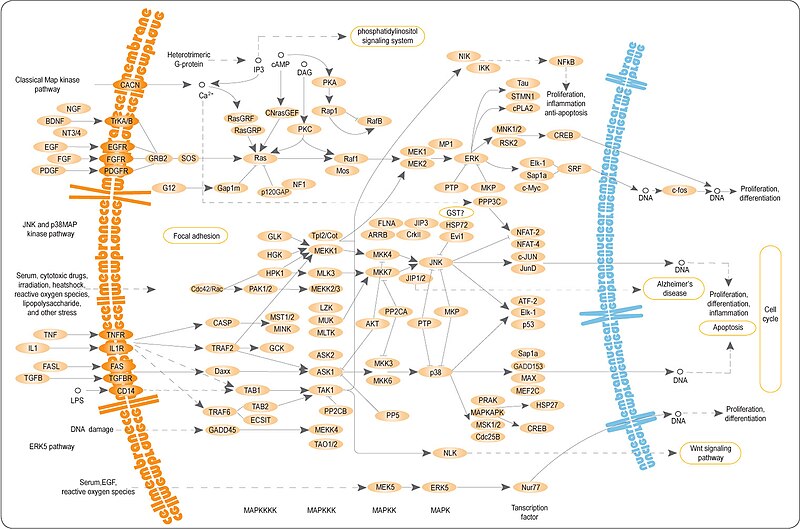
The most interesting findings related to the increase in the in MAPK-related signaling proteins 2.5 hours after massage, suggesting an augmentation of mitochondrial biogenesis signaling with massage therapy.

File:MAPKpathway.jpg

Genome profiling results showed a reduction in the nuclear abundance of NFkB 2.5 hours after massage, in parallel with reduced phopshorylation of HSP27 and IL-6 protein content.

In summary, these findings suggest that massage could contribute to an attenuated production of inflammatory cytokines which may reduce pain by similar mechanisms observed by conventional anti-inflammatory drugs. With this in mind, for sure there is a need of more studies using such techniques to understand more about the most effective massage protocols. Moreover, more is needed to understand when not to use massage. In fact, considering the possibility of such intervention of reducing the inflammatory response, one wonders the potential of such intervention to impair the adaptive responses to resistance exercise. Needless to say that more studies are needed using resistance exercise models and well trained individuals to ascertain the potential and the limitations as well as the contra-indications of massage therapy.

Tuesday, 9 August 2011

Free online issue of Biomedical Basis of Elite Performance

In anticipation of the London 2012 Olympics and as a build-up to the opening of registration for The Biomedical Basis of Elite Performance Meeting, The Journal of Physiology and Experimental Physiology have just launched a free online issue on The Biomedical Basis of Elite Performance.


Experimental Physiology: http://ep.physoc.org/site/misc/virtualissue.xhtml
The Journal of Physiology: http://jp.physoc.org/site/misc/virtualissue.xhtml


Papers selected for this special online issue draw attention to exercise and training as extreme physiological variants. A considerable breadth of physiology is covered, including genes and human performance, the regulation of muscle protein and collagen turnover, tendon responses to exercise, fatigue (local and central), age and sex differences in response to training, vasodilator function, oxygen transport and oxygen demand, motor drive and motor unit recruitment, respiratory fatigue and mitochondrial and fuel metabolism.

Papers were selected by Paul Greenhaff (JP) and Michael White (EP).


Wednesday, 30 March 2011

Want to know more about Near Infrared Spectroscopy?

If you are curious about Near Infrared Spectroscopy (NIRS) and happen to be in Edinburgh in the next few weeks make sure you visit the science festival.

The primary application of NIRS to the human body uses the fact that the transmission and absorption of NIR light in human body tissues contains information about hemoglobin concentration changes. When a specific area of the brain or a muscle is activated, the localized blood volume in that area changes quickly. Optical imaging can measure the location and activity of specific regions of the brain or muscles by continuously monitoring blood hemoglobin levels through the determination of optical absorption coefficients.

My PhD student Catherine Hesford has just started a blog here. Catherine will conduct an experiment with members of the public and will explain the theory behind NIRS together with my colleague Professor Chris Cooper.

The Science Festival in Edinburgh starts on the 9th of April, all details are available here.

Popular Posts


Followers